Why Smart Employers Are Re-Thinking Remote Work
Depending who you talk to, remote work is either alive and well, or a thing of the past – feelings about it and company posture to support it (or not) really varies.
Many senior leaders are stuck in old school thinking. “If cars aren’t in the parking lot, work's not getting done”. (Real quote I heard once, by the way.)
It's important to recognize that the way that we work has changed. Put aside for the moment AI coming in hot; I'm simply talking about technology in general, enabling us to not only work from anywhere, but also kind of forcing us to be “on” at all times. I mean, who among us hasn't checked our phone for work email or texts after hours?
If you're anything like me, your phone is always within arm’s reach and you check it pretty much hourly (at least) without even thinking. Whether it's intentional or simply habit, it happens. I'm not proud of it and I really should force myself to unplug once in a while because we ALL need a break sometimes – but, I digress! My point is that we are essentially always on. Even on vacations, we are casually monitoring our emails for emergencies.
So I would ask the question: if we are constantly available for work (thus, accepting the negatives of technology) should we not be able to also enjoy its perks?
Here are common objections to remote work and my thoughts:
“How will I know if people are working? What if they slack off?”
There are plenty of software options that allow you to track productivity. Plus, what are the folks that work with these people (colleagues, clients) saying about them? Is the person non-responsive or is the work so seamless they don’t even know (or care) where their colleague/provider/etc. is sitting?“What if they cut out early one day?”
So what? I mean, if they are getting the work done and have to skip out a few minutes early for an appointment now and then and it’s understood that the time/work will be made up, what’s wrong with that? I am more interested in the level of productivity accomplished in a day than I am how many hours someone’s butt was in a chair.
“What about culture and teamwork?!”
If done with intention, culture CAN be built remotely, although I do agree that in person experiences have value! Bringing a newbie in for a week for training and to meet the team is ideal! Then perhaps a few times a year outside of that for the holiday party, summer picnic, etc. If you hire within a few hours of your office, it’s easy and cost effective to do this. Having just one day a week in office can work well too because then everyone knows everyone, but you’re also able to hire from a larger radius since folks will typically drive further if it’s just once a week. If your company is truly 100% remote or there is no office, there are companies out there that will literally host in-person meetings/gatherings for you!
I know this can work, as I have great relationships with my clients and have met very few in person!
Consider the two biggest benefits of remote work for you as the employer:
Bigger/better talent pool
If I’m working on a search that’s 3 days per week in office, I search within 30 miles. Most people don’t want to drive more than 40 minutes or so if they're doing it 3x a week. So out of the gate you’ve got a smaller number of people.
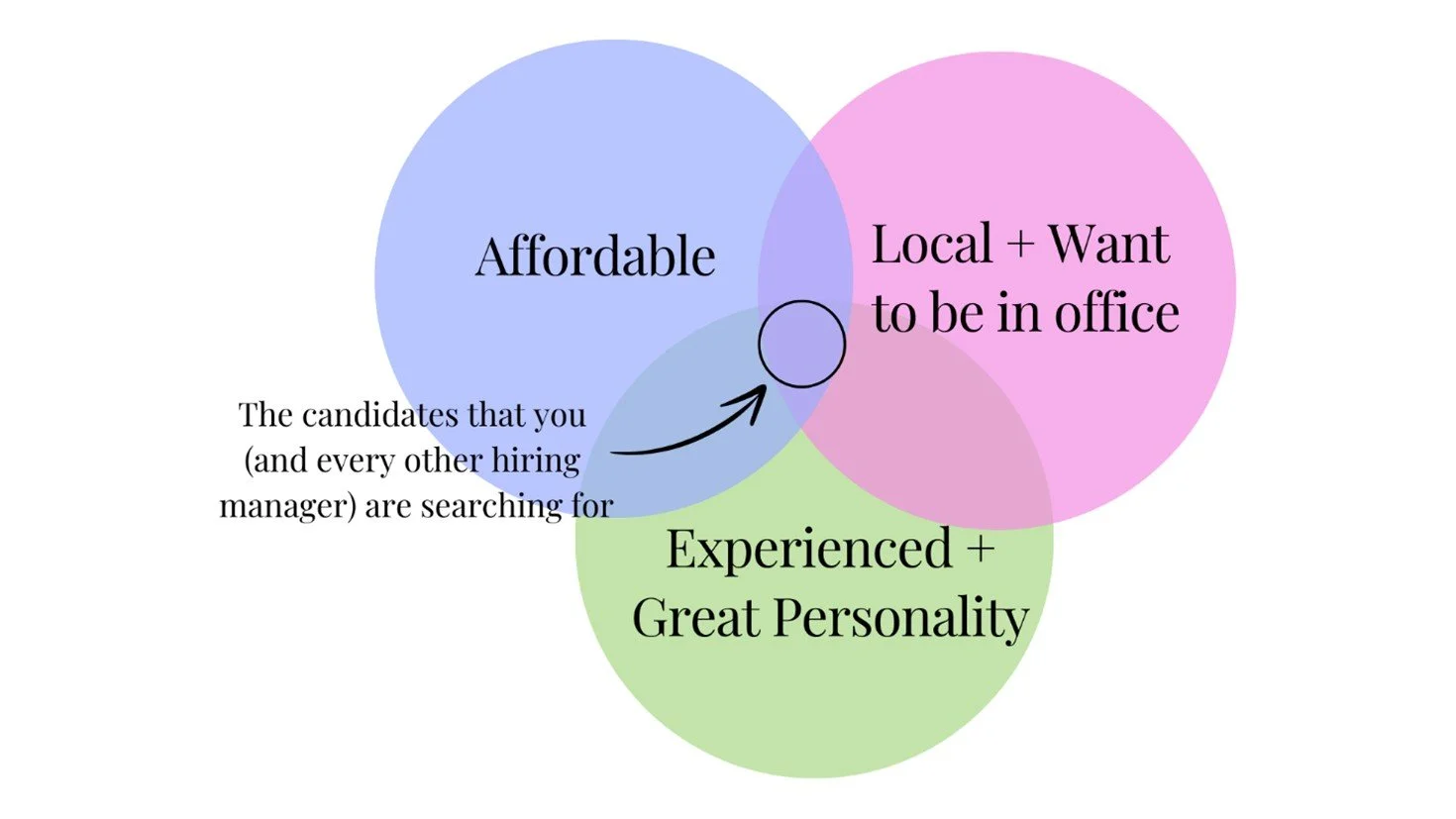
Consider this illustration – you and everyone else want this small group of folks right in the middle. You can sometimes have two, but rarely three. So where do you bend? Pay out the nose, sacrifice quality, or give flexibility. (Easy choice if you ask me).
2. Happier employees/lower turnover (and thus, happier clients and more $$)
What’s the saying - If you hold sand too tightly in your hand, it will run through your fingers? You’re an employer – not a babysitter or a daycare. Hire the right people, trust and empower them to do the job, and then step back and watch what happens. When you give people flexibility and trust to build a life that integrates with work (because let’s be honest, actual work/life balance doesn’t exist) and make them feel personally invested, they will work to keep the perks.
Working from home can let someone get a kid on and off the bus and they’ll be grateful for that flexibility (and savings on before/after school care). Thus, they’ll work hard to keep that in place. I work from home and often start at 5 AM and go until 5 PM. Sure, I break during the day for the gym or run an errand some days, and I get the kids ready for school and on/off the bus, but I’m putting in way more than 8 hour days. If I were working for someone, they’d be getting way more than the 40 hours per week they paid me for.
And here’s the truth: if someone is slacking off at home, the reality is, they were probably going to slack off in the office – it would just be their brain wandering instead of their body.
🚩Some red flags I keep an eye out for in the interview process:
Showing up late/rescheduling/no showing for calls – if this is what our first interaction is like, what can I expect once hired?
Presenting poorly on a video. Remote work is not a free pass to look like a slob – the interviewer is assessing how you’ll show up on video calls with clients – if you can’t get out of your pj’s, that’s a problem
Stating that remote work “saves you so much money on day care”. Yes, childcare is expensive – I’m a working mom and I’ve been there, I get it! My kids are 8 and 11 and leave me alone when they’re home now, but that was not the case five years ago. If you have young kids, it is impossible to dedicate your full time and attention to the job without someone else caring for them so there needs to be a support system or plan in place.
Refusing to ever go on-site for training, events, etc. Remote work is one thing but outright refusal to ever go on site is…a turnoff to say the least.
“If you’re a candidate seeking remote work, show up in a way that gives confidence to the prospective employer that you can do the job. And if you’re an employer, keep an open mind to what you can do with the right people and technology in place!”